Published: 2019-12-17
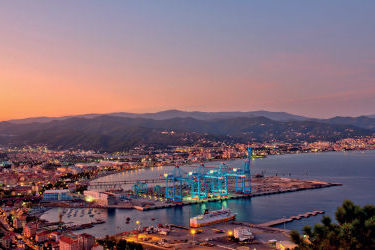
The facility, located in Vado Ligure, Italy, is unique in terms of services and technology, featuring an automated yard and an appointment system for trucks.
Investments necessary to make the project a reality totaled at €450m, €180m of which brought to the table by APM Terminals and further €43m coming from project financing. The terminal was commissioned by Autorità di Sistema Portuale del Mar Ligure Occidentale (Western Ligurian Sea System Port Authority) and will be managed by APM Terminals for the next 50 years.
Morten Engelstoft, CEO, APM Terminals, said, "Strengthening our presence in Vado Ligure reaffirms our commitment to the region and the role it plays on the European logistics map. Vado Gateway is an important part of A.P. Moller – Maersk's overall ambitions and strategy to become an integrated container logistics company that truly connects and simplifies global trade to help our customers grow and thrive."
Vado Gateway is expected to act as a logistics hub for cargo moving to the northern part of Italy, as well as the country's northern neighbors, such as Switzerland, Germany or northeastern France. It is therefore referred to as one of the maritime terminals of the "New Silk Road".
The new terminal has already secured two important services operated by A.P. Moller-Maersk. Starting in February 2020, vessels on Maersk's ME2 service, connecting the Mediterranean to the Middle East and India, and MMX service, connecting the Mediterranean to North America, will call Vado Gateway.
Once fully operational, Vado Gateway, together with the nearby Reefer Terminal of Vado Ligure, also managed by APM Terminals, will allow the Port of Vado to handle over 1m TEUs per year, approximately 900k of which going through the new entity.
Vado Gateway is a semi-automated terminal. It will initially operate on a 450 m part of the quay, but from July 2020 its whole 700 m extension will be available for use. With a depth at quay level of 17.25 m and height of 4.5 me above sea level, the terminal will be able to accommodate and operate the latest generation ultra large container ships (ULCS).
The yard used for container storage and handling is the first in Italy to be completely automated. Automatic Rail Mounted Gantry (ARMG) cranes will work autonomously under the remote supervision, a major contribution to safety. No personnel will be present in the area while containers are being moved. Access to the yard will only be allowed for maintenance work when the cranes are not operating.
The containers unloaded at Vado Gateway will be immediately recorded with a dynamic video camera set on the ship-to-shore (STS) cranes with an operator on board, sending information to the Terminal Operating System (TOS). The system allows for each container to be tracked in real time.
Container handling from the quay to internal exchange areas, and from there to the yard and exchange areas for road transport (exchange grid), will be carried out by straddle carriers - hybrid-powered equipment with an operator on board, receiving instructions directly from the TOS.
Vado Gateway also features an innovative truck gating system. 14 automated reversible lanes provide access to the terminal, facilitating flow management by means of the truck appointment system. Truck drivers arriving at the access gate will have previously booked their appointment and received confirmation via a web interface connected to the information systems. Upon arrival at the port, they will proceed through an optical reader, identifying the driver by the vehicle number plate and container number.
Hinterland connectivity has also been taken into account. APM Terminals' target is to move 40% of the containers handled at Vado Gateway by rail. The necessary infrastructure is still under development. At first, there will be 4-5 trains linking Vado with intermodal hubs in northern and eastern Italy, including Milan and Padua.
By the end of January 2020 the terminal is expected to accommodate 390 employees. A significant number of the available positions has been filled through requalification programmes specifically aimed at the unemployed.

TOC Americas 18-20 October 2022 Lima

Baltic and Black Sea Ports & Shipping 27-29 September 2022 Palanga

Intermodal Freight Forum Europe 2022 8 February 2022 Online

International Rail Forum & Conference 2022 5-7 October 2022 CZ/Prague

SIL Barcelona 31 May 2022 ES/Barcelona